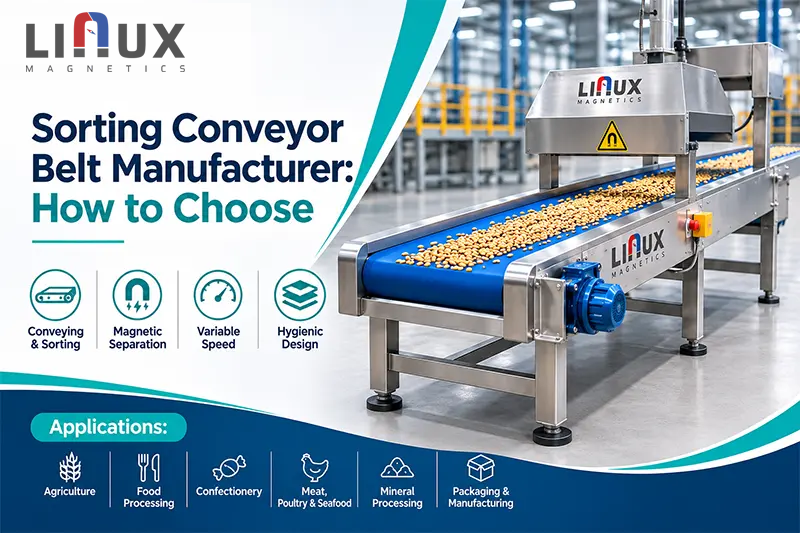
A sorting conveyor belt is an integral part of a number of production, food-processing and material-handling applications that require the conveying, inspection and sorting of products. Combined with magnetic separation technology, a conveyor belt can also be used to remove suitable magnetic contaminants from a product stream.
Selecting the right conveyor and associated products can enhance a variety of operations that handle confectionery, meat, poultry, seafood, grain, minerals and more.
Linux Magnetics, an Ahmedabad-based manufacturer and exporter of magnetic and vibratory equipment, is also an industrial sorting conveyor belt manufacturer.
Sorting Conveyor Belt: Definition & Application
A sorting conveyor belt operates differently based on its construction. The conveyor is used to move goods for either inspection or automatic and manual sorting. Some conveyors are configured to utilise a magnetic separator and remove suitable magnetic contaminants.
A number of industries employ sorting conveyor belts, including:
- Agriculture
- Food processing
- Confectionery
- Meat, poultry and seafood processing
- Mineral processing
- Manufacturing and packaging
How does it Work?
The conveyor belt moves products along a conveyer by driving a belt via a motor, and providing supporting rollers and a framework to maintain the belt's integrity and alignment. Items are then inspected or sorted, depending on the configuration.
The following components are integral to belt conveyors:
- Conveyor Belt
- Drive Motor and Speed Control
- Rollers and Frame
- Sorting and Inspection Area
- Magnetic Separator
Types
The buyer should understand the types of conveyors available, to discuss the requirements intelligently with the manufacturer.
The following common types of conveyor belts can be utilised in a variety of production, processing and material-handling applications:
| Type | Description |
|---|---|
| Flat Belt Conveyor | Moves products over a generally level surface |
| Variable-Speed Sorting Conveyor | Allows the belt speed to be varied to suit the process |
| Magnetic Sorting Conveyor | Utilises a magnetic separator to remove suitable magnetic contaminants |
| Food-Processing Sorting Conveyor | Incorporates features to suit the requirements of a hygienic and clean environment |
| Customised Sorting Conveyor | Designed to the buyer's requirements |
How to choose the right Belt
Choosing the right conveyor belt is reliant on the process and not simply on a price comparison.
1. Choose the Belt Width
The size of the products that can be transported and the spacing between the items depends upon the width of a sorting conveyor belt, depending on the belt speed.
A wider belt is generally suited to larger products or greater spacing between items. Narrower belts are often used for smaller items.
2. Determine the Conveyor Belt Speed
The speed of the conveyor belt is another important factor that can impact the flow rate of the process
A higher belt speed can generally mean faster processing, but can decrease the inspection or separation time.
3. Determine the Load Capacity and Throughput
Load capacity and throughput are two terms that refer to the amount of material that can be handled by the conveyor, but in different units.
4. Check Belt Material and Hygiene
For food-related products; the belt and its compatibility with the hygiene, cleaning regime and chemicals used in the processing environment are crucial.
5. Determine Magnetic Separation Requirements
Magnetic separation requirements are dependent on the product, the type of contaminant and the level of separation required.
6. Identify Construction and Maintenance
The frame and roller assembly in the conveyor belt are usually engineered to be compatible with a certain operating environment. The choice of materials and accessibility of the roller and belt assembly determine the amount of maintenance needed.
Choosing the right sorting conveyor belt manufacturer for the process will decrease the frequency of downtime and increase ease of operation.
Specifications to Check
Linux Magnetics sells Sorting conveyor Belts with variable speed, smooth side walls and corrosion-resistant body. The listed industries that utilise the conveyor belt include agriculture, confectionery and food processing.
The belts come with the following specifications:
- Conveyor width 50–500 mm
- Conveyor speed approximately 1.3–2.0 m/s
- Load capacity Listed as 1–25 kg
Why Choose Linux Magnetics?
Linux Magnetics provides a list of products, which include magnetic separation equipment, magnetic belts, floor sweepers, magnetic lifters and sorting belts. The official web page gives an overview of sorting belts, including applications in food processing.
Linux Magnetics customers can:
- Review the company's dedicated sorting belt page
- Discuss the product that needs to be handled and the required sorting process
- Request model-specific information on belt sizes and speed
- Clarify whether magnetic separation would be included in a configuration
- Confirm delivery, installation, warranty and support arrangements
For product details, visit the Linux Magnetics Sorting Belt page.
Conclusion
A good sorting conveyor belt manufacturer, will ensure that the belt is suited to the product, with a throughput rate and working environment.
When inquiring with Linux Magnetics, specify the product type, belt width, load or throughput rate, desired speed. Also specify if you need magnetic separation.
For product enquires and further information, visit the Linux Magnetics Enquiry Page.