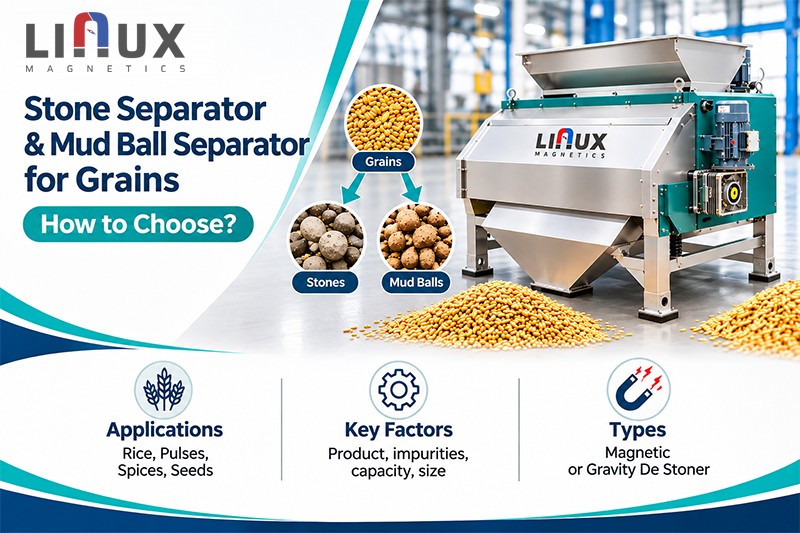
Stones, mud balls, iron and other contaminants are found in grains, pulses and spices. IT’Ss essential to separate them because they may cause issues during further processing.
Stone Separator and Mud Ball Separator for Grains are some of the devices that can help improve the purity of agricultural products before further processing or packaging.
Linux Magnetics, a manufacturer and exporter of vibrating and magnetic machinery from Ahmedabad, Gujarat, has an interesting device called Magnetic De stoner. Businesses looking for a reliable Stone Separator Manufacturer can evaluate equipment based on their grain processing requirements and the types of impurities they need to remove.
What is a stone separator or mud ball separator?
A stone separator is an equipment that helps in separating stones from the grains, seeds, pulses, and similar products. Mud ball separators help in segregating the mud balls and other impurities that cannot be cleaned through normal equipment.
Stone separators and mud ball separators can be selected for their ability to enhance grain purity prior to processing, grading, packaging and other activities.
Linux Magnetics manufactures the Magnetic De stoner, which is used for removing mud balls and iron impurities from wheat, dal and other pulses.
Applications for these separators can include:
- Processing of rice and wheat: Separation of unwanted impurities from the raw material to be processed further.
- Processing of pulses and dal: Removal of dirt balls, stones, and other unwanted substances.
- Processing of spices: Separation of unwanted substances before grinding and packaging.
- Processing of seeds: Enhancement of the purity of seeds to be further processed.
Depending upon the raw materials to be processed and unwanted substances to be removed, magnetic de stoner or gravity de stoner and various types of magnetic separators can also be considered.
How does a magnetic de stoner work?
A magnetic de stoner can be used for removing foreign materials from the product. The working principle depends on the design and the contents of the processed material. The Linux Magnetics product page indicates that the machine has a feeding hopper, vibrating tray and PU conveyor belt, while the process uses fluidisation and deck oscillation to separate particles based on their characteristics and behaviour on the deck, as well as magnetic attraction for suitable impurities.
A magnetic de stoner typically contains these parts:
- Feeding hopper
- Vibrating tray or separation deck
- PU conveyor belt
- Magnetic assembly
- Discharge points
Stones vs. mud balls: Which machine removes which impurities?
Stones and mud balls can be undesirable in agricultural materials, but the two items have different properties. A stone separator is typically used for removing stones, while a mud ball separator is used for removing mud balls. However, the choice of the right machinery also depends on the other materials present and the desired results.
| Stone separator | Mud ball separator |
|---|---|
| A stone separator is typically used for removing stones and other foreign materials that can be separated based on density, size, shape or other attributes. | Mud balls can be challenging to remove from certain materials due to their size and density. A stone separator is not always suitable for this application. |
| This equipment is normally considered for processing rice, wheat, pulses, seeds and other similar products, depending on the contaminants present. | The choice of the equipment and its settings depends on the characteristics of the mud balls. |
Magnetic de stoner vs. gravity de stoner
Magnetic and gravity de stoners are both used for removing impurities from the grain or pulse processing line, but the machines operate on different principles.
| Feature | Magnetic de stoner | Gravity de stoner |
|---|---|---|
| Main separation approach | Combines physical separation with magnetic attraction for suitable contaminants | Primarily uses differences in density and particle behaviour |
| Mud ball removal | Depends on the machine design and properties of the mud balls | Depends on differences between the mud balls and the product |
| Stone removal | Uses the machine's physical separation mechanism where applicable | Uses density and movement differences to separate suitable stones |
| Ferrous metal removal | Magnetic assembly can attract suitable ferrous contaminants | Requires a separate magnetic system if magnetic separation is needed |
| Best selection criteria | Product characteristics, contaminant type and magnetic separation requirements | Product density, particle behaviour and required separation performance |
A magnetic de stoner may be selected when both physical impurity separation and magnetic force are needed. A gravity de stoner may be selected when the differences in the densities of the product and the impurities contribute to the desired separation performance.
How to select the right stone and mud ball separator
The choice of a stone and mud ball separator involves more than comparing prices. Review these specifications before requesting a quotation:
1. Define the product that you process
Indicate whether you process wheat, rice, pulses, dal, spices, seeds or another product.
2. Define the impurities
Indicate whether you process stones and gravel, mud balls, iron and other magnetic materials, glass pieces or other undesirable items.
3. Define the processing capacity
Processing capacity is normally indicated in kg/hour or tonne/hour. The capacity depends on the product, the amount of material that needs to be processed and the processing line requirements.
4. Requirements for the magnetic strength
In case your machine needs to separate magnetic substances from your product, you should ask the manufacturer about the magnet type and magnetic strength required for the chosen configuration.
5. Overall machine size
Inquire from the manufacturer regarding its dimensions: length, width, height, inlet and outlet points of the product.
6. Machine structure and maintenance
Inquire from the manufacturer regarding the structure of the machinery, the conveyor belt, vibrations unit, dust control, and the availability of parts for maintenance purposes.
7. Conditions for trial or product performance verification
For complex applications, request the supplier for trial or product performance verification.
Why buy from Linux Magnetics?
Linux Magnetics lists a range of magnetic equipment on its portfolio, including magnetic de stoners, magnetic roller separators, drum separators, magnetic pulleys, magnetic lifters and other products. As a reliable Stone Separator Manufacturer and mud ball separator, the company can be contacted to discuss product requirements, machine configurations and application-specific specifications.
When you are considering a Linux Magnetics de stoner for your processing line, you can:
- Review the product page for the magnetic de stoner.
- Define the type of grain, pulse or spice that you process.
- Share the list of impurities that you want to remove with the supplier.
- Inquire about model-specific processing capacity, size and magnetic system performance.
- Confirm the installation, maintenance, delivery and warranty conditions.
- Order the required documentation for an international purchase, if applicable.
If you have any questions about the scope of supply, contact a Linux Magnetics representative.
Enquire about a magnetic de stoner
The choice of a magnetic de stoner depends on the product that you process, the impurities that you need to remove, the required processing capacity and the performance that you expect from the machine.
Whether you are searching for a reliable Stone Separator Manufacturer or exploring a Mud Ball Seperator for grains, pulses and spices, Linux Magnetics can help you identify a suitable solution for your application.
When you contact Linux Magnetics, provide information about the material that you process, the anticipated processing capacity, the impurities that you need to remove and the size of the available space. This information will help the supplier recommend the right model and address your requirements.