
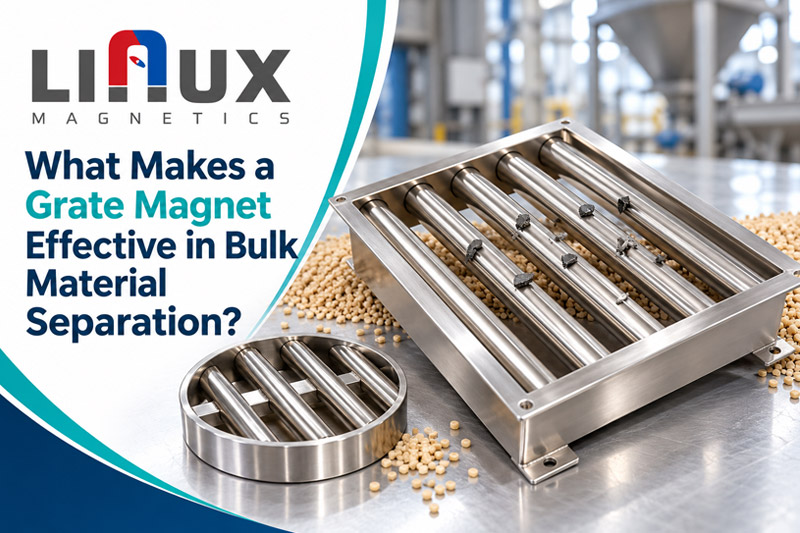
Bulk material processing commonly consists of powders, granular materials, minerals, chemicals, ingredients of food products, plastics, and other freely flowing materials. Even tiny amounts of ferrous particles can contaminate the product or damage equipment downstream. A grate magnet is a simple, effective device for removing ferrous contamination from dry, free-flowing materials.
Grate magnets use magnetic bars housed in a frame to attract and hold ferrous particles while allowing the product to flow through. Their effectiveness depends on magnetic strength, gradient, configuration, material flow, construction, and installation. Linux Magnetics supplies magnetic grilles designed for high-intensity separation across a range of industrial applications.
How Grate Magnets Improve Bulk Material Separation
Grate magnets are commonly installed at material flow points such as hoppers, chutes, and catch bins. As material passes through the grate, ferrous particles are attracted to the magnetic rods and held while the clean product continues downstream. Placement and configuration are critical because separation performance relies on close contact between particles and the magnetic field.
For higher protection, systems can use multiple magnetic stages or custom-shaped grilles to match existing equipment. Linux Magnetics offers customised sizes and shapes to suit different installation requirements.
Key Factors That Make a Grate Magnet Effective
1. Strong Magnetic Field
Magnetic strength is critical. High-intensity fields are especially important for fine powders and small particles where the magnetic force must overcome particle inertia and flow dynamics to capture ferrous contaminants.
2. High-Gradient Magnetic Design
Gradient and field geometry determine how effectively the magnet interacts with passing material. High-gradient designs increase the magnetic force in close proximity to rods, improving pickup of weakly magnetic or small particles.
3. Correct Grate Configuration
Bar spacing, number of stages, and overall shape (round, square, rectangular) must match the material characteristics and installation point to maximize contact between particles and magnetic surfaces.
4. Quality Construction
Durable frames and corrosion-resistant materials such as stainless steel preserve alignment and make cleaning easier—important for hygiene-sensitive industries like food and pharmaceuticals.
5. Easy Cleaning and Maintenance
Designs that allow quick inspection and removal of collected ferrous particles reduce downtime and keep separation performance consistent.
Where Are Grate Magnets Used?
They are widely used wherever free-flowing dry materials need protection from ferrous contamination:
- Food processing
- Chemical processing
- Pharmaceutical production
- Plastics manufacturing
- Ceramic industries
- Mineral processing
- Recycling applications
- Powder and granular material handling
Why Choose Linux Magnetics?
Linux Magnetics manufactures a range of magnetic separation equipment and material-handling equipment, including magnetic grilles, rods, drawers, plates, drums, and overband separators. Our solutions are designed for robust industrial use and can be customised to meet plant-specific needs.
Conclusion
An effective grate magnet combines high magnetic efficiency, appropriate design, durable construction, and easy maintenance. When selected and installed according to the material properties and flow characteristics, grate magnets are an excellent method for reducing ferrous contamination in powders, granules, minerals, chemicals, food products, plastics, and ceramics.
Choosing the right manufacturer and configuring the system correctly are important steps toward ensuring long-term product quality and equipment protection. For assistance, please contact us.