In the industries which process grains, pulses, seeds, spices, and other food substances, it is necessary to remove impurities. Heavy impurities such as stones, mud balls, metals, glass, and other may enter the raw material during the collection process. Conventional destoners are generally used for separating heavy particles, while the magnetic destoners provide yet another level of separation.
It combines controlled material flow, deck movement, and magnetic separation principles to handle different types of impurities. This makes it a useful option for processing applications where both heavy foreign materials and metallic contamination need attention. Linux Magnetics manufactures and supplies magnetic destoners for applications across grain, pulse, seed, food, spice, and granule industries.
How Magnetic Destoners Improve Material Cleaning
They provide an effective approach to cleaning grains, pulses, seeds, spices, and other agricultural materials by combining heavy-particle separation with magnetic separation. During processing, stones, mud balls, glass pieces, metallic particles, and other unwanted impurities can enter the material stream.
The vibrating deck and controlled material movement help separate heavier contaminants, while the magnetic section attracts suitable metallic particles. This combined operation can improve the cleanliness of processed materials and provide additional protection for downstream equipment.
They are suitable for applications across grain, pulse, seed, spice, food, and granule processing.
How Is It Different From Conventional Destoning?
The key difference is the additional magnetic separation capability.
Conventional destoners generally separate stones and other heavy materials by using differences in density, weight, airflow, and vibration. This can be effective for removing dense foreign particles, but metallic contamination may require an additional magnetic separator.
It incorporates magnetic separation into the cleaning process. This means the machine can address multiple contamination concerns within a material-handling operation.
For processors, this can help reduce the need for separate stages where the application and plant configuration allow magnetic equipment to perform the required separation.
1. Combines Multiple Separation Principles
One of the main advantages of it is its combination of mechanical and magnetic separation.
Material movement across the deck helps separate particles according to their physical characteristics. Heavy particles can move toward designated outlets, while lighter product follows a different path. At the same time, magnetic particles can be attracted toward the magnetic surface.
2. Helps Remove More Than Stones
The name “destoner” can suggest that the machine is designed only for stones. However, they can address a wider range of unwanted materials.
Depending on the material and operating conditions, the equipment can help remove:
- Stones
- Mud balls
- Metallic particles
- Glass pieces
- Other heavy foreign materials
- Certain unwanted contaminants
3. Controlled Material Feeding
Consistent feeding is important for any separation machine. If material enters too quickly or unevenly, the separation process may become less effective.
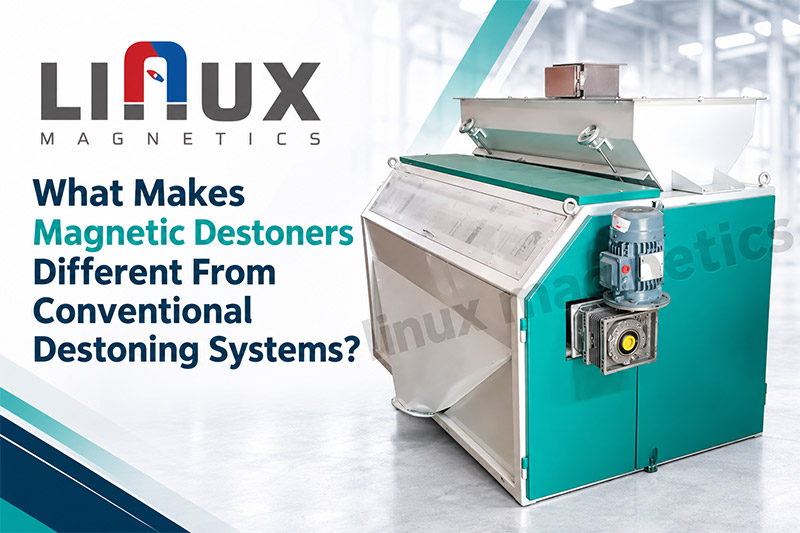
It incorporates a feeding hopper and vibrating tray to support balanced material flow. The conveyor arrangement also helps maintain the movement of material through the magnetic separation area.
Controlled flow allows the machine to process material more consistently and gives the separation system a better opportunity to act on unwanted particles.
4. Designed for Industrial Processing
Modern food and agricultural processing plants require equipment that can operate continuously while remaining practical to maintain. It therefore needs more than a strong magnetic system; its overall construction, accessibility, material flow, and operating requirements are also important.
It has a fully enclosed mild-steel structure designed to provide strength and help control dust. Its listed features include easy operation, low power consumption, mobility, a belt-changing arrangement, and a finished industrial design.
5. Suitable for Different Industries
They can be used in several industries where raw materials need cleaning before further processing.
Common applications include:
- Seed processing
- Grain processing
- Food processing
- Spice processing
- Pulses processing
- Granule processing
These applications make the equipment useful for processors handling materials where stones, mud balls, metallic particles, and other foreign matter may be present.
Why Choose Linux Magnetics?
Linux Magnetics has been involved in manufacturing and exporting magnetic and vibratory equipment since 2008. Our product range includes magnetic separators, magnetic destoners, vibrating screens, vibro feeders, magnetic drums, magnetic grills, and other industrial equipment.
It is specifically positioned for removing impurities from wheat, rice, grains, pulses, and related materials. Linux Magnetics also provides magnetic equipment for applications across food, chemical, fertilizer, recycling, pharmaceutical, mining, and other industries.
Conclusion
Magnetic destoners differ from conventional destoning systems because they can combine heavy-particle separation with magnetic separation. Instead of focusing only on stones and other dense contaminants, they can also help address metallic impurities within the material stream.
For grain, pulse, seed, spice, food and granule processors, such an integrated method can be a practical way of improving the cleaning of raw materials before further processing. Selecting the right Magnetic Destoner Manufacturer and Supplier from Linux Magnetics is therefore an important part of developing a reliable and efficient material-cleaning system. For expert assistance and inquiries, please contact us today.